Preloader Close
Increase Energy Savings with Reflective Insulation Bubble Sheets

Send us Email
Blog Details
Can TIRI X1 Help Reduce Electricity Consumption?
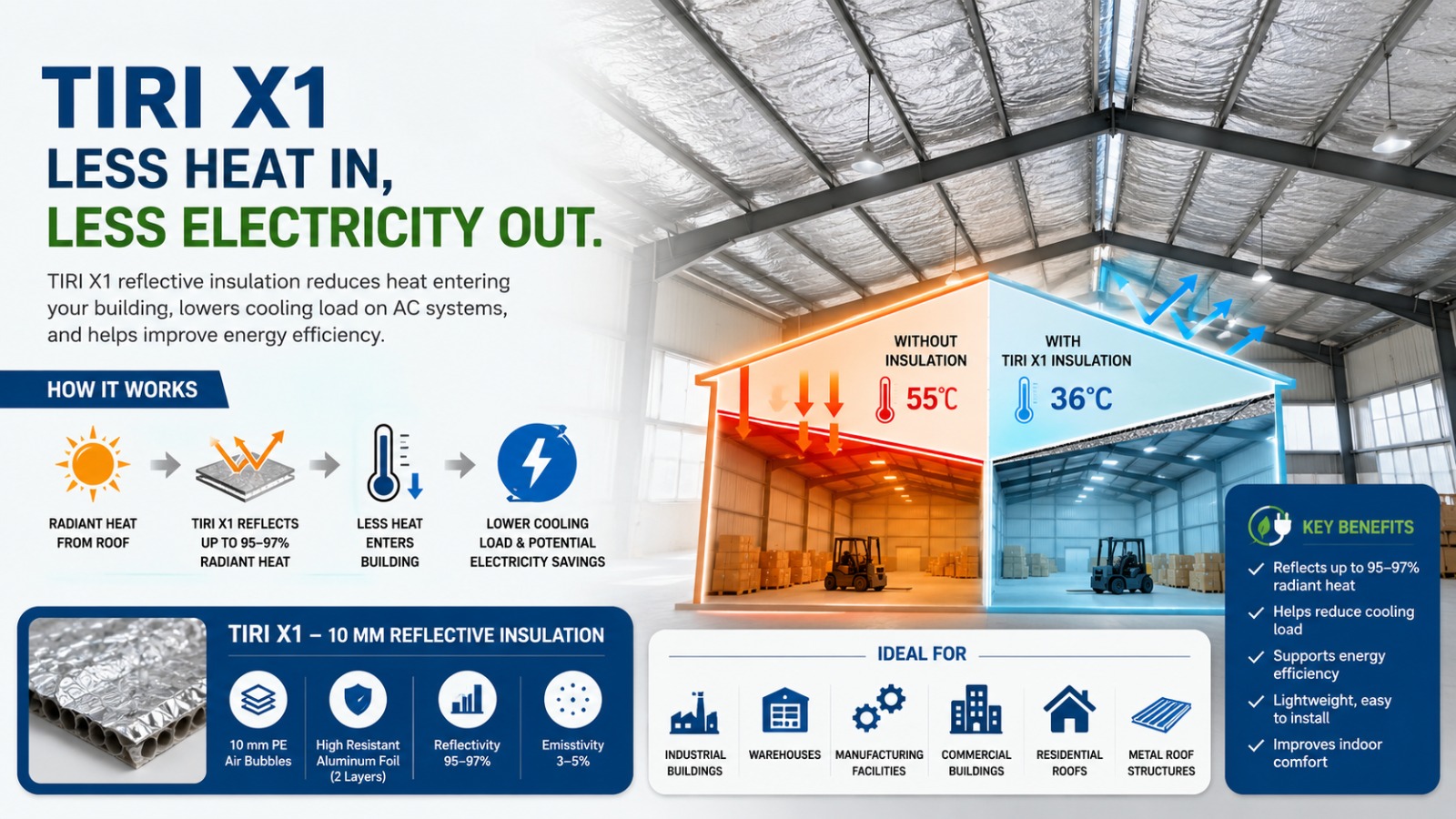
High indoor temperatures can increase the workload on air-conditioning systems, especially in buildings with metal roofs. TIRI X1 reflective insulation is designed to reduce heat transfer and help improve indoor thermal comfort.
But can it actually help reduce electricity consumption? Yes, it can help lower cooling demand, although the actual savings depend on the building and operating conditions.
What Is TIRI X1?
- TIRI X1 is a 10 mm reflective bubble insulation made with fiber-free PE air bubbles sandwiched between two layers of high-resistant pure aluminum foil.
- It offers 95–97% reflectivity and 3–5% emissivity, helping reflect radiant heat before it significantly increases indoor temperatures.
How Does TIRI X1 Help Save Electricity?
- The basic principle is simple:
- When less heat enters through the roof, air-conditioning systems may not need to work as hard or as frequently to maintain the desired indoor temperature.
- This can be particularly useful in warehouses, factories, commercial buildings, and other structures with large roof areas.
Less Heat Entering → Lower Indoor Heat Gain → Lower Cooling Load → Potentially Lower AC Electricity Consumption
Does TIRI X1 Reduce AC Usage?
- It can help reduce the cooling load placed on an AC system.
- By reflecting radiant heat from the roof, TIRI X1 can help maintain a more stable indoor environment. This may allow HVAC systems to operate more efficiently, particularly during periods of high outdoor temperatures.
- However, insulation is only one factor affecting electricity consumption.
How Much Electricity Can TIRI X1 Save?
- There is no single electricity-saving percentage that applies to every building.
- Actual savings depend on factors such as:
-
- o Building design and roof construction
- o Local climate and outdoor temperature
- o Roof area and orientation
- o Existing insulation
- o Indoor occupancy and heat generation
- o AC capacity and operating hours
- o Desired indoor temperature
- Therefore, TIRI X1 should be considered a heat-reduction and energy-efficiency solution, rather than a product with a guaranteed electricity-saving percentage.
Why Is Reflectivity Important?
- TIRI X1 has a reflectivity of 95–97% and low emissivity of 3–5%. Its aluminum foil surfaces help reflect radiant heat instead of allowing a large portion of it to contribute to heat gain.
- This reflective property is especially relevant when TIRI X1 is installed correctly with the required air space for reflective insulation performance.
Where Can TIRI X1 Be Used?
- TIRI X1 can be considered for applications where roof-related heat gain is a concern, including:
-
- o Industrial buildings
- o Warehouses
- o Manufacturing facilities
- o Commercial buildings
- o Metal-roof structures
- o Residential roofs
- o Other construction applications requiring reflective thermal insulation
Is TIRI X1 an Alternative to Air Conditioning?
- No.
- TIRI X1 does not replace an air-conditioning system. Instead, it works as part of the building's thermal management strategy by helping reduce heat transfer.
- The objective is to make it easier for the HVAC system to maintain the required indoor temperature.
What Makes TIRI X1 a Practical Insulation Solution?
- TIRI X1 combines reflective aluminum foil with PE air-bubble insulation in a lightweight format. TIRI Systems positions its reflective insulation range as an energy-efficiency solution for reducing radiant heat and improving indoor comfort.
- Its lightweight construction can also make handling and installation easier compared with some conventional insulation materials.
Frequently Asked Questions
- 1. What is TIRI X1?
- TIRI X1 is a reflective insulation made with PE air bubbles and high-resistant aluminum foil.
- 2. How does TIRI X1 work?
- It reflects radiant heat to help reduce heat entering through the roof.
- 3. Can TIRI X1 reduce electricity consumption?
- Yes, it can help reduce cooling loads and potentially lower AC electricity consumption.
- 4. What is the thickness of TIRI X1?
- TIRI X1 is a 10 mm reflective bubble insulation solution.
- 5. What is the reflectivity of TIRI X1?
- TIRI X1 offers approximately 95–97% reflectivity.
- 6. What is the emissivity of TIRI X1?
- TIRI X1 has a low emissivity of approximately 3–5%.
- 7. Can TIRI X1 be used under metal roofs?
- Yes, TIRI X1 is suitable for applications involving metal roofing where radiant heat is a concern.
- 8. Does TIRI X1 help improve indoor comfort?
- Yes, it can help reduce roof-related heat gain and support more comfortable indoor temperatures.
- 9. Can TIRI X1 replace air conditioning?
- No, it complements HVAC systems by helping reduce the cooling load.
- 10. Where can TIRI X1 be used?
- It can be used in warehouses, factories, commercial buildings, and other heat-prone structures.
Final Takeaway
- TIRI X1 can contribute to lower electricity consumption by reducing roof-related heat gain and cooling demand. Its 95–97% reflectivity and 3–5% emissivity make it a suitable reflective insulation option for buildings where radiant heat is a major concern.
- For the best results, insulation selection and installation should be based on the building's roof type, climate, usage, and thermal requirements rather than thickness alone.