Preloader Close
Increase Energy Savings with Reflective Insulation Bubble Sheets

Send us Email
Blog Details
Is TIRI Bubble Wrap Insulation Suitable for Layer Farms?
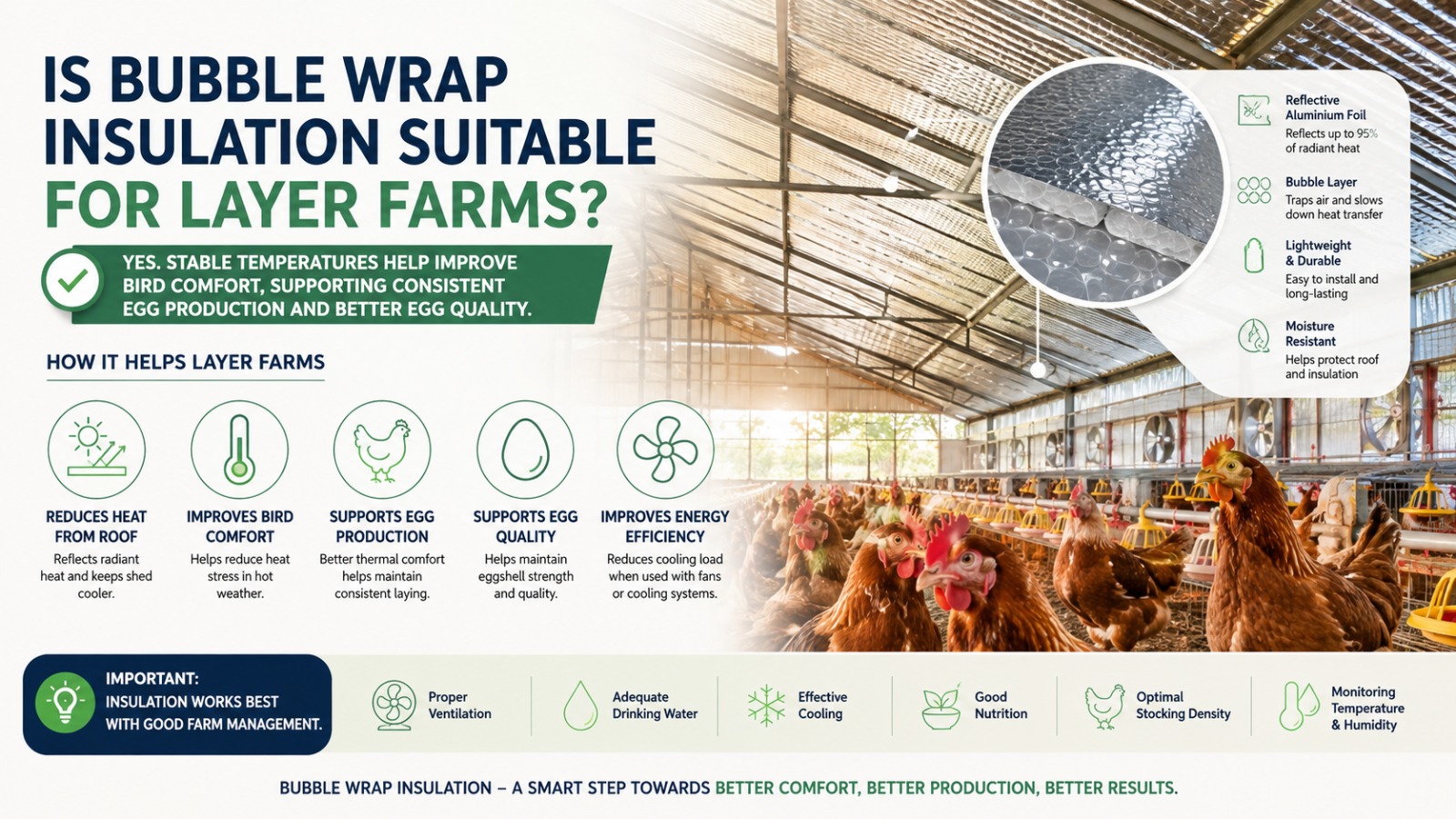
Yes, TIRI Bubble Wrap Insulation is suitable for layer farms, especially poultry sheds with metal roofs exposed to intense sunlight. It helps reduce radiant heat entering through the roof and can contribute to a more stable indoor environment for laying hens.
Temperature management is an important part of successful layer farming. During hot weather, excessive heat can cause stress in birds, affecting feed intake, water consumption, egg production and egg quality. While insulation is not a standalone solution, it can be an important part of an overall poultry-house heat-management strategy.
Why Is Heat Management Important in Layer Farms?
Layer chickens are sensitive to high temperatures, particularly when hot conditions continue for long periods. When birds experience heat stress, they may reduce their feed intake and increase their water consumption as they attempt to regulate body temperature.
Prolonged heat stress can also affect productive performance, including egg production and certain egg-quality characteristics.
The roof is particularly important because poultry sheds often use metal roofing. Under direct sunlight, metal sheets can become extremely hot and transfer radiant heat toward the interior of the shed.
This is where reflective insulation can play an important role.
How Does TIRI Bubble Wrap Insulation Work?
TIRI Bubble Wrap Insulation is designed as a reflective thermal barrier. It combines reflective aluminium foil surfaces with an air-bubble layer to help reduce heat transfer.
The reflective surface helps reflect radiant heat rather than allowing it to contribute directly to the indoor heat load.
A simplified process is:
Strong Sunlight → Hot Metal Roof → Radiant Heat Transfer → TIRI Reflective Insulation → Reduced Roof-Related Heat
By reducing heat gain through the roof, the insulation can help create a more manageable thermal environment inside the poultry house.
TIRI reflective insulation is designed to reflect a high percentage of radiant heat, making it particularly relevant for structures exposed to strong solar radiation.
Benefits of TIRI Bubble Insulation for Layer Farms
1. Helps Reduce Roof Heat Gain
The roof is one of the largest surfaces exposed to sunlight. In metal-roof poultry sheds, this can become a significant source of indoor heat.
TIRI Bubble Wrap Insulation acts as a reflective barrier beneath the roof, helping reduce the amount of radiant heat reaching the poultry-house interior.
This can be particularly useful during hot summer conditions.
2. Supports Bird Comfort
Excessive heat can make laying hens uncomfortable and increase the risk of heat stress.
By reducing roof-related heat gain, reflective insulation can contribute to a more comfortable indoor environment.
However, insulation should always be considered together with proper ventilation and cooling because poultry-house temperature depends on several factors.
3. Helps Support Consistent Egg Production
TIRI insulation does not directly increase egg production.
Its role is to help manage one of the environmental factors that can negatively affect poultry productivity—excessive heat.
When heat stress becomes severe, hens may reduce feed intake and experience changes in productive performance. Maintaining better thermal conditions can therefore help support consistent flock performance when combined with proper nutrition, water availability, ventilation and overall farm management.
4. Can Help Maintain Egg Quality
Egg quality depends on several factors, including genetics, bird age, nutrition, calcium availability, disease management and environmental conditions.
Heat stress can negatively affect certain egg-quality parameters, including eggshell characteristics.
By helping reduce excessive heat exposure, thermal insulation can support the environmental conditions required for maintaining consistent egg quality.
5. Can Reduce Cooling Requirements
Some layer farms use fans, air circulation systems or other cooling methods to manage high temperatures.
When reflective insulation reduces heat entering through the roof, the cooling system may have less heat load to manage.
The actual energy savings will depend on the poultry-house design, climate, ventilation system, insulation installation and operating conditions. Therefore, insulation should be viewed as a way to reduce thermal load, rather than as a guaranteed electricity-saving solution.
Where Can TIRI Bubble Insulation Be Used?
TIRI Bubble Wrap Insulation can be considered for different poultry structures, particularly those with metal roofing.
- Layer poultry farms
- Broiler poultry sheds
- Commercial poultry houses
- Metal-roof poultry sheds
- Large-span poultry buildings
- PEB poultry structures
- Agricultural sheds
- Existing poultry houses suitable for retrofit installation
The appropriate insulation product should be selected according to the building's requirements rather than simply choosing the thickest available option.
Factors such as roof design, shed dimensions, climate, ventilation, installation space and desired thermal performance should be considered.
Can TIRI Insulation Be Installed in Existing Layer Farms?
Yes, it can potentially be installed in existing layer farms, subject to the condition and design of the existing structure.
Before installation, farmers or project teams should evaluate:
- Existing roof sheets
- Roof condition
- Purlin arrangement
- Available installation space
- Ventilation openings
- Existing cooling systems
- Shed height and dimensions
- Local temperature conditions
- Number of birds
- Required thermal performance
Proper installation is important because reflective insulation works as part of a complete roof system. The reflective surface, air space and installation arrangement can influence its performance.
Is Bubble Insulation Enough to Prevent Heat Stress?
No.
TIRI Bubble Wrap Insulation can help reduce heat entering through the roof, but it cannot replace ventilation, cooling or proper flock management.
An effective poultry-house heat-management strategy may include:
- Reflective roof insulation
- Proper natural or mechanical ventilation
- Fans and air circulation
- Cooling systems where required
- Adequate drinking water
- Appropriate stocking density
- Proper nutrition
- Temperature and humidity monitoring
- Regular shed maintenance
The objective is to manage the complete indoor environment rather than depend on a single solution.
Why Is Roof Insulation Useful During Summer?
During summer, direct solar radiation can significantly increase the temperature of metal roofing.
Without an appropriate thermal barrier, some of this heat can contribute to the indoor heat load.
Installing reflective insulation before the peak summer period can help farmers prepare their poultry sheds for higher temperatures.
A proactive approach allows farm operators to inspect the roof, improve ventilation, check cooling equipment and evaluate insulation requirements before extreme heat becomes a major challenge.
What Makes Reflective Insulation Different?
Traditional insulation systems primarily focus on slowing conductive heat transfer. Reflective insulation works differently by using a low-emissivity reflective surface to reduce radiant heat transfer.
This makes reflective insulation particularly relevant to applications where solar radiation is a major source of heat gain, such as metal-roofed poultry sheds.
However, reflective insulation should be selected and installed according to the specific building system. Its performance should not be judged only by thickness.
Frequently Asked Questions
Is TIRI Bubble Wrap Insulation suitable for layer farms?
Yes. It can be suitable for layer farms, particularly metal-roof poultry sheds, where reducing radiant heat from the roof is an important concern.
Does TIRI insulation increase egg production?
Not directly. It helps reduce roof-related heat gain and can support better thermal conditions. This may help minimise productivity losses associated with excessive heat when combined with proper poultry management.
Can TIRI Bubble Insulation reduce heat stress?
It can help reduce one source of heat exposure—radiant heat from the roof. However, ventilation, cooling, water and other management practices are also essential.
Can it improve egg quality?
It may contribute indirectly by helping manage excessive heat. Egg quality depends on multiple factors, including nutrition, genetics, bird age and environmental conditions.
Is it suitable for metal poultry sheds?
Yes. Reflective bubble insulation is particularly relevant to metal-roof structures because these roofs can absorb significant solar radiation during hot weather.
Can it be installed in an existing layer farm?
Potentially, yes. Existing structures should be assessed for roof condition, construction, ventilation and installation requirements before work begins.
Can bubble insulation replace fans?
No. Insulation and ventilation serve different purposes. Insulation helps reduce heat entering the building, while fans help move air and remove heat and moisture.
Which TIRI product is best for my layer farm?
The right product depends on the shed design, roof construction, climate and required thermal performance. Product selection should ideally be based on the specific project requirements.
Conclusion
TIRI Bubble Wrap Insulation can be a practical thermal-management solution for layer farms, especially poultry sheds with metal roofs exposed to strong sunlight.
By helping reduce radiant heat entering through the roof, it can contribute to a more stable indoor environment and support better bird comfort during hot weather.
This can be particularly important because excessive heat can affect feed intake, bird behaviour, egg production and egg-quality parameters.
However, insulation should not be treated as a standalone solution. The best results come from combining reflective roof insulation with proper ventilation, cooling, drinking-water management, nutrition and overall flock management.
For farmers planning a new layer farm or upgrading an existing poultry shed, evaluating roof heat gain and thermal insulation can be an important step toward better environmental control.
TIRI Systems — Smarter Thermal Protection for Poultry Farms.