Preloader Close
Increase Energy Savings with Reflective Insulation Bubble Sheets

Send us Email
Blog Details
How Does Reflective Insulation Work? A Complete Guide
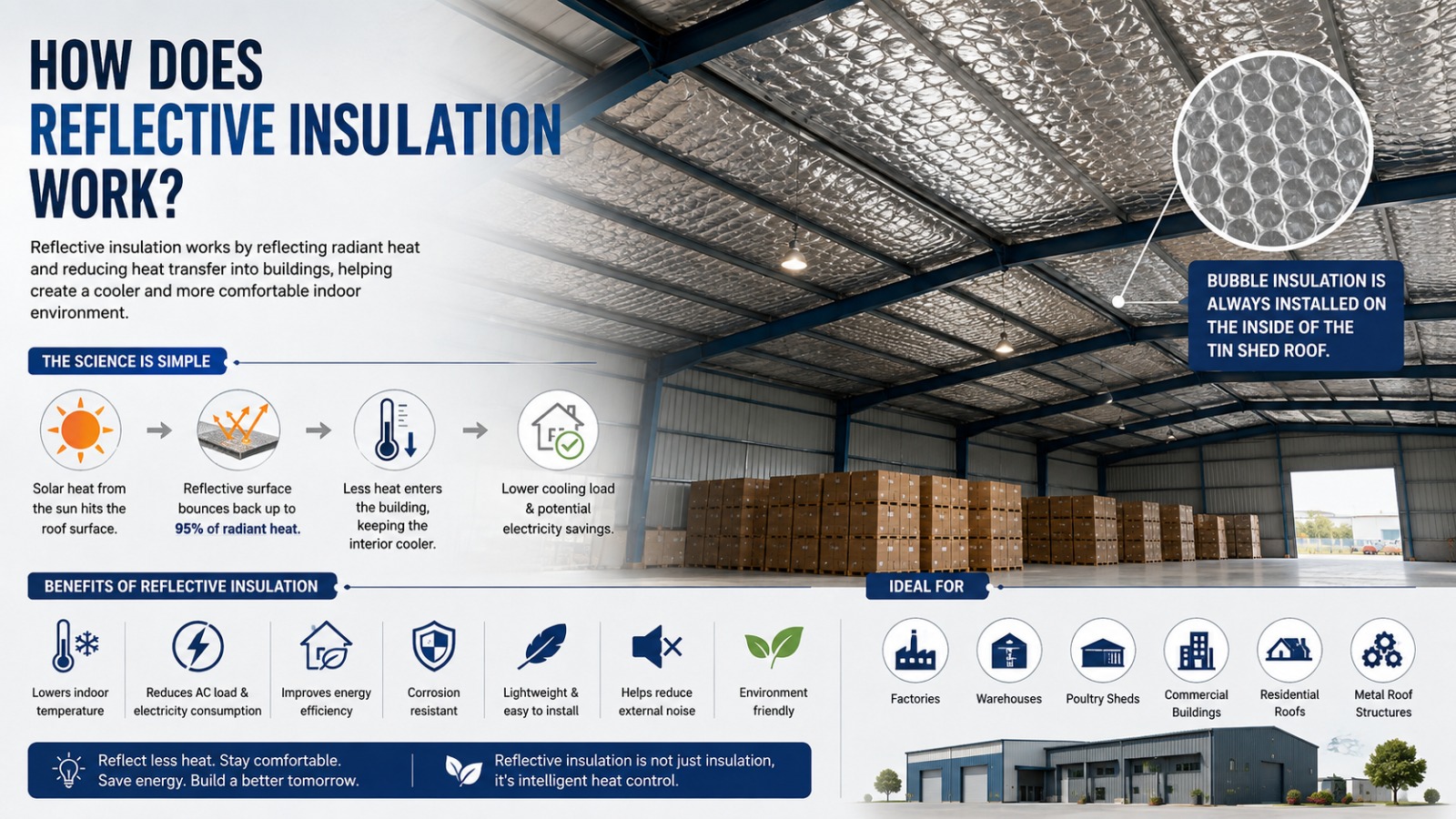
Reflective insulation is a thermal insulation solution designed to reduce heat gain by reflecting radiant heat away from a building. Unlike conventional insulation materials that primarily slow heat conduction, reflective insulation uses a low-emissivity reflective surface to reduce radiant heat transfer through roofs and walls.
This makes reflective insulation particularly useful in buildings where roofs are exposed to strong sunlight, such as warehouses, factories, poultry farms, commercial buildings, and residential structures.
How Does Reflective Insulation Work?
- Reflective insulation works by reflecting radiant heat rather than simply absorbing it. Its reflective surface, commonly made using aluminum foil, has low emissivity, which means it emits and absorbs relatively little radiant heat.
- During hot weather, solar radiation heats the external roofing surface. Without an effective thermal barrier, some of this heat can transfer toward the interior of the building.
- A reflective insulation layer helps reflect a significant portion of the radiant heat back toward the source, reducing radiant heat transfer into the building.
- For reflective insulation to perform effectively, an appropriate air space is generally important because its primary mechanism is controlling radiant heat across an air gap.
What Makes Reflective Insulation Different?
- Traditional insulation materials such as mineral wool, glass wool, and foam mainly resist conductive and convective heat transfer. Reflective insulation takes a different approach by controlling radiant heat.
- Many reflective insulation products combine reflective aluminum foil with an insulating core. Bubble-based reflective insulation, for example, can use air-filled bubbles between reflective foil layers.
- The reflective surfaces help reduce radiant heat transfer, while the enclosed air provides additional thermal resistance.
- This combination can make reflective insulation suitable for metal roofs and other applications where radiant heat is a major concern.
Can Reflective Insulation Reduce Indoor Heat?
- Yes, reflective insulation can help reduce heat entering a building through exposed roofs and other surfaces.
- By reducing radiant heat transfer, it can help maintain a more comfortable indoor environment, particularly during hot and sunny conditions.
- Actual performance depends on factors such as roof construction, orientation, air gaps, ventilation, installation quality, climate, and the type and thickness of insulation used.
- Therefore, reflective insulation should be considered as part of the building's overall thermal design rather than as a standalone solution for every type of heat transfer.
Where Is Reflective Insulation Commonly Used?
- Reflective insulation can be used across a wide range of applications where controlling radiant heat is important, including:
-
- o Industrial warehouses
- o Manufacturing plants
- o Commercial buildings
- o Poultry and livestock sheds
- o Agricultural structures
- o Cold-storage and utility buildings
- o Residential roofs
- o Garages and workshops
- o Metal-roofed structures
- Its lightweight construction can also make installation practical for large roof areas.
Can Reflective Insulation Help Reduce AC Electricity Consumption?
- Reflective insulation can potentially reduce cooling demand by limiting heat entering the building through the roof.
- When the indoor space gains less heat, an air-conditioning system may need to operate less intensively to maintain the desired temperature.
- The actual electricity savings cannot be guaranteed because they depend on factors such as:
-
- o Building size
- o Insulation coverage
- o AC efficiency
- o Operating hours
- o Outdoor temperature
- o Ventilation
- o Existing insulation
Why Is Installation Important?
- The performance of reflective insulation depends not only on the material but also on how it is installed.
- Gaps, damaged foil surfaces, incorrect overlaps, poor sealing, or installation without the required air space can affect thermal performance.
- For industrial and commercial roofs, professional installation and proper detailing around joints, edges, fasteners, and penetrations can help ensure more consistent performance.
Is Reflective Insulation Worth Considering?
- From a building-performance perspective, reflective insulation is most valuable when radiant heat is a significant contributor to heat gain.
- Metal roofs exposed to intense sunlight are a common example where controlling radiant heat can be particularly important.
- A properly selected and installed reflective insulation system can complement other thermal measures such as ventilation, conventional insulation, cool roofing, and efficient air-conditioning systems.
- The key is to select the right insulation type and thickness for the building's roof construction, climate, application, and thermal requirements rather than choosing a product based only on thickness or appearance.
Frequently Asked Questions
- 1. How does reflective insulation work?
- Its reflective surface helps reflect radiant heat and reduce heat transfer into buildings.
- 2. Does reflective insulation reflect sunlight?
- Yes, its reflective surface can reflect a significant portion of incoming radiant energy and help reduce heat absorption.
- 3. Is reflective insulation suitable for metal roofs?
- Yes, reflective insulation is commonly used beneath metal roofing to help control radiant heat gain.
- 4. Can reflective insulation reduce indoor temperature?
- It can help reduce heat entering a building and contribute to lower indoor temperatures when properly installed.
- 5. Does reflective insulation save electricity?
- It can potentially reduce cooling demand, which may contribute to lower air-conditioning electricity consumption.
- 6. Is reflective insulation better than conventional insulation?
- They work differently, and combining reflective insulation with other insulation methods can provide broader thermal control.
- 7. Does reflective insulation need an air gap?
- Yes, an appropriate air space is generally required for effective radiant-barrier performance.
- 8. Where can reflective insulation be used?
- It can be used in warehouses, factories, poultry sheds, commercial buildings, agricultural structures, and residential roofs.
- 9. What is reflective insulation made of?
- Many reflective insulation products use aluminum foil combined with materials such as air bubbles or foam insulation.
- 10. Does thickness matter in reflective insulation?
- Yes, product construction and thickness can influence thermal performance along with installation and roof conditions.
- 11. Can reflective insulation be used in poultry farms?
- Yes, it can help reduce radiant heat entering poultry sheds and support better thermal comfort for birds.
- 12. Is reflective insulation suitable for warehouses?
- Yes, it is suitable for warehouse roofs where solar heat gain can increase indoor temperatures.
- 13. Does reflective insulation stop all heat transfer?
- No, it primarily addresses radiant heat transfer and should be combined with measures that control other heat-transfer mechanisms.
- 14. Can reflective insulation be installed under an existing roof?
- In many cases, it can be incorporated into roof systems depending on the existing roof structure and available installation space.
- 15. How effective is reflective insulation?
- Its effectiveness depends on product construction, reflective properties, air space, installation quality, roof design, climate, and building conditions.
Conclusion
- Reflective insulation works by using a low-emissivity reflective surface to reduce radiant heat transfer into a building. This makes it particularly useful for sun-exposed roofs, metal structures, warehouses, factories, poultry sheds, and other buildings where controlling heat gain is important.
- When correctly selected and installed, reflective insulation can contribute to improved indoor thermal comfort and potentially lower cooling requirements.
- For the best results, reflective insulation should be evaluated as part of a complete building thermal-management strategy.