Preloader Close
Increase Energy Savings with Reflective Insulation Bubble Sheets

Send us Email
Blog Details
How Does Reflective Insulation Reduce Heat Inside a Building?
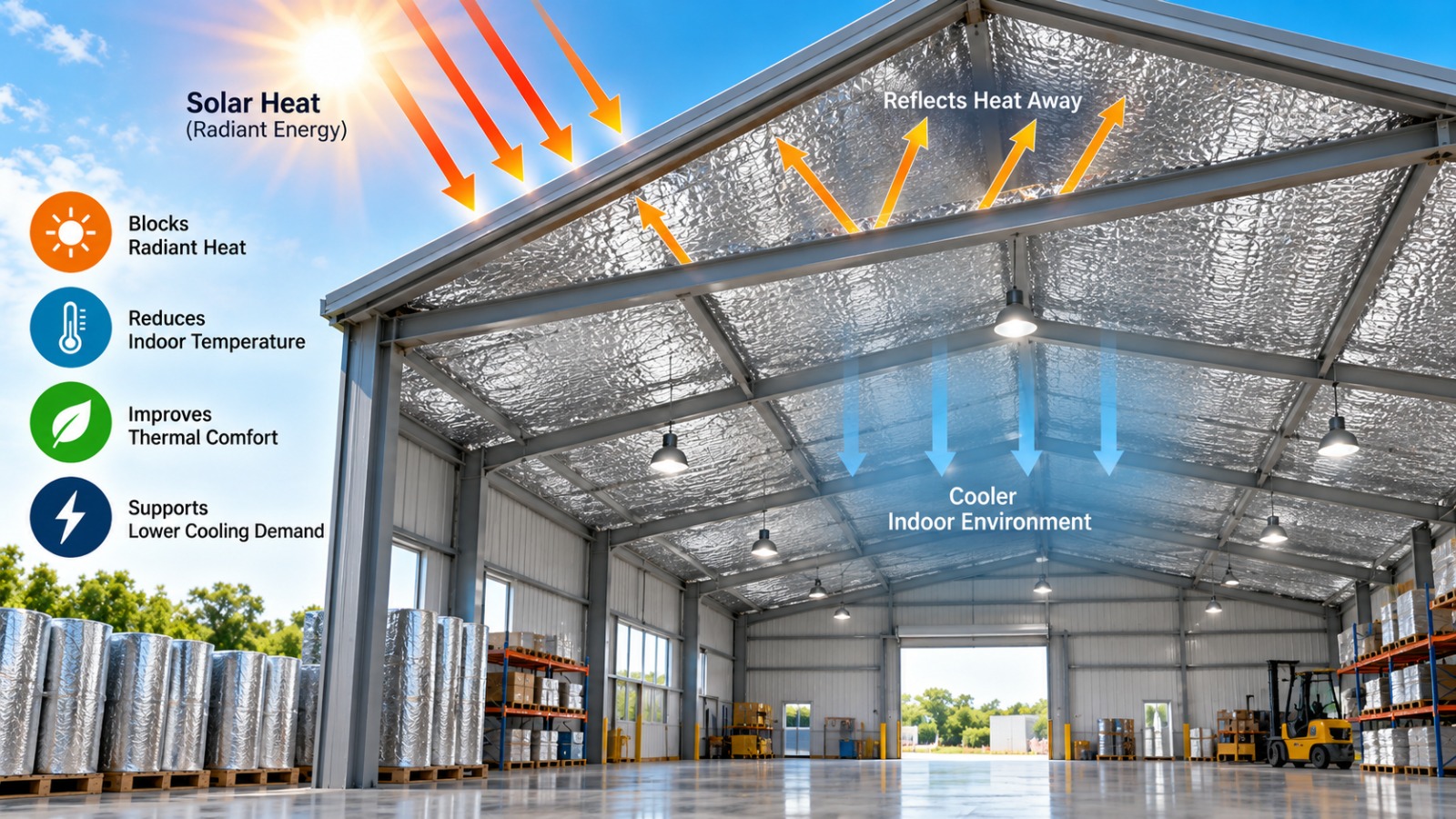
Yes, reflective insulation can help reduce heat entering a building by reflecting radiant heat away from the building instead of allowing it to be absorbed and transferred indoors. This makes reflective insulation particularly useful in hot climates, especially beneath metal roofs, where solar radiation can significantly increase indoor temperatures.
Unlike conventional insulation, which primarily slows heat transfer through conduction, reflective insulation works mainly by reducing radiant heat transfer. Understanding this difference is important when selecting the right insulation system for a building.
-
What Is Reflective Insulation?
- Reflective insulation is an insulation system that incorporates a low-emissivity reflective surface, commonly aluminium foil, designed to reflect radiant heat.
- When sunlight heats a roof, the roof surface absorbs solar energy and becomes hot. Some of this heat can then radiate toward the underside of the roof and the building interior.
- A properly installed reflective surface can reflect a significant portion of this radiant energy back toward the roof side, helping reduce the amount of radiant heat reaching the occupied space.
- For products such as reflective foil insulation systems, performance depends not only on the reflective surface but also on the overall construction, installation method, air gaps and surrounding building materials.
-
How Does Reflective Insulation Reduce Heat?
- The process can be understood in three simple steps:
- 1. Solar radiation heats the roof
- A roof exposed to direct sunlight absorbs solar energy and its temperature rises.
- 2. Heat radiates from the roof toward the interior
- The hot roof can transfer heat inward through radiation, conduction and convection.
- 3. The reflective surface helps control radiant heat
- A low-emissivity foil surface reflects radiant energy and reduces the amount of radiant heat exchanged across an appropriate air space.
- This is why reflective insulation can be particularly relevant for metal buildings, warehouses, factories, PEB structures, industrial sheds, agricultural buildings and other spaces exposed to strong solar radiation.
-
Is Reflective Insulation Different From Conventional Insulation?
- Yes. The two approaches control heat transfer differently.
- Conventional bulk insulation generally works by providing resistance to conductive heat flow.
- Reflective insulation primarily addresses radiant heat transfer, particularly when a low-emissivity surface faces an air space.
- This means reflective insulation should not simply be judged as a direct replacement for every type of conventional insulation.
- In many building designs, different insulation approaches can be selected according to the roof construction, climate, ventilation, desired thermal performance and application requirements.
-
Why Is Reflective Insulation Useful in Hot Climates?
- In hot regions, roofs can receive intense solar exposure for several hours each day. This can create substantial heat loads, particularly in buildings with large roof areas.
- Reflective insulation can help reduce radiant heat transfer from the roof assembly toward the occupied space.
- As a result, it can contribute to a more comfortable indoor environment and reduced dependence on mechanical cooling, depending on the building design and other factors.
- The actual improvement will vary according to roof material, orientation, installation quality, air movement, climate, building usage and the complete insulation system.
-
Where Can Reflective Insulation Be Used?
- Reflective insulation can be considered for several applications, including:
-
- o Industrial sheds and factories
- o Warehouses and storage facilities
- o PEB buildings
- o Metal-roofed structures
- o Agricultural and farm buildings
- o Commercial buildings
- o Workshops
- o Sports and recreational facilities
- o Retrofit roofing applications
- For each application, the insulation should be selected and installed according to the roof construction and intended thermal-performance requirements.
-
Why Does Installation Matter?
- Reflective insulation does not achieve its intended function simply because a foil layer is present.
- Correct installation is essential. The orientation of the reflective surface, provision of the required air space, sealing and joining details, and compatibility with the roof assembly can all influence performance.
- A professional assessment should therefore consider the complete roof system rather than looking at the reflective material in isolation.
-
TIRI Systems and Reflective Insulation
- TIRI Systems focuses on insulation solutions designed for applications where controlling heat transfer is important.
- Its reflective insulation approach is particularly relevant to structures where roofs are exposed to substantial solar radiation.
- For project-specific selection, factors such as roof type, building use, local climate, installation configuration and required thermal performance should be evaluated before choosing an insulation system.
-
Key Takeaway
- Reflective insulation reduces heat primarily by controlling radiant heat transfer through its low-emissivity reflective surface.
- It can be especially useful in hot climates and buildings with sun-exposed roofs, but its effectiveness depends on the complete roof assembly and correct installation.
-
Frequently Asked Questions
- 1. How does reflective insulation reduce heat? — It reduces radiant heat transfer by reflecting radiant energy away from the building interior.
- 2. Does reflective insulation keep a building cool? — Yes, it can help reduce heat entering the building and improve indoor thermal comfort when properly installed.
- 3. Is reflective insulation suitable for hot climates? — Yes, it is particularly relevant where buildings experience high solar radiation and roof heat gain.
- 4. Does reflective insulation work without an air gap? — Its radiant-heat-control performance generally depends on having an appropriate air space adjacent to the reflective surface.
- 5. Can reflective insulation be used in warehouses? — Yes, reflective insulation can be considered for warehouses, especially those with large sun-exposed roof areas.
- 6. Can reflective insulation reduce air-conditioning requirements? — It can reduce heat gain and potentially lower cooling demand, although actual savings depend on the complete building design and operating conditions.
- 7. Is reflective insulation the same as conventional insulation? — No. Reflective insulation primarily controls radiant heat, while conventional bulk insulation primarily resists conductive heat flow.
- 8. Can reflective insulation be used in PEB buildings? — Yes, reflective insulation can be used in PEB applications when the product and installation method are appropriate for the roof assembly.
- 9. Does roof colour affect heat gain? — Yes. Roof colour and solar reflectance influence how much solar energy the roof absorbs, so they should be considered along with the insulation system.
- 10. What determines the performance of reflective insulation? — Performance depends on the reflective surface, air-space configuration, roof construction, installation quality, climate and the building's overall thermal design.