Preloader Close
Increase Energy Savings with Reflective Insulation Bubble Sheets

Send us Email
Blog Details
Can Reflective Insulation Be Installed in an Existing Layer Farm?
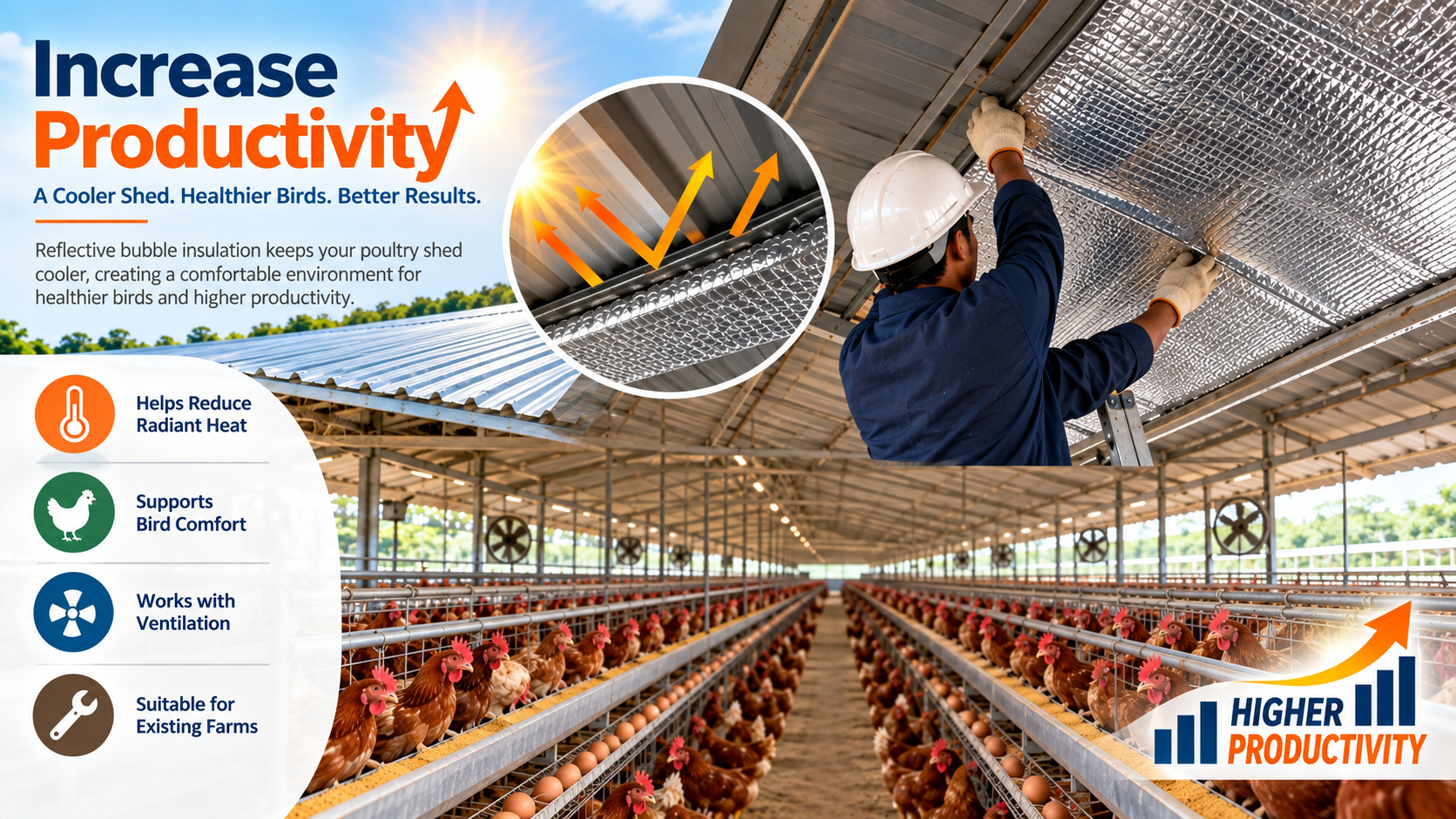
Yes, reflective insulation can potentially be installed in an existing layer farm, provided the existing structure is first assessed for roof condition, ventilation, accessibility, and installation requirements. For poultry layer farms, where maintaining a suitable indoor environment is important for bird comfort and farm operations, reflective insulation can be considered as part of a broader roof heat-management strategy.
Existing layer farms often have metal or sheet roofing that can absorb significant solar heat during summer. This heat can increase the temperature inside the poultry house, particularly when the building has large roof surfaces exposed to direct sunlight. Installing reflective insulation beneath the roof can help reduce the amount of radiant heat transferred toward the interior.
-
Why Consider Reflective Insulation for an Existing Layer Farm?
- Layer farms are designed around maintaining a controlled and suitable environment for poultry. Excessive heat inside the shed can make environmental management more difficult and may affect bird comfort, feed and water consumption, ventilation requirements, and overall farm management.
- Reflective insulation works primarily by reflecting radiant heat rather than simply blocking heat through thickness. Its performance depends on the material, installation method, air space, roof construction, and overall building design.
- For an existing layer farm, this makes the roof area an important place to evaluate when looking for ways to manage solar heat entering the building.
-
Can It Be Installed Without Rebuilding the Farm?
- In many cases, reflective insulation can be considered for retrofit installation, meaning it is added to an existing structure rather than requiring complete roof replacement.
- However, every existing layer farm is different. Before installation, the roof should be inspected for corrosion, leakage, damaged sheets, loose fasteners, structural issues, and areas that may require repair.
- The installation team should also consider the existing purlins, roof profile, available fixing points, electrical services, ventilation openings, and other equipment installed inside the poultry house.
- This assessment helps determine the most appropriate installation approach.
-
What Should Be Checked Before Installation?
- Several factors should be evaluated before installing reflective insulation in an existing layer farm:
-
1. Roof Condition
- Damaged, heavily corroded, or leaking roof sheets should be repaired or replaced where necessary before insulation installation.
-
2. Existing Ventilation
- Poultry houses require effective ventilation. Insulation should not block designed air inlets, exhaust paths, fans, or other ventilation systems.
-
3. Available Installation Space
- The installer should identify suitable areas for fixing and determine how the reflective insulation will be positioned beneath the existing roof.
-
4. Structural Condition
- The roof-supporting structure should be checked to ensure that the proposed installation method is compatible with the existing building.
-
5. Farm Operations
- Installation planning should account for birds, workers, equipment, feeding systems, electrical installations, and routine farm activities.
-
Does Reflective Insulation Replace Ventilation?
- No. Reflective insulation should not be treated as a replacement for proper poultry-house ventilation.
- Ventilation and insulation address different aspects of environmental management. Ventilation helps remove hot air and moisture and provides air movement, while reflective insulation can help reduce radiant heat transfer from the roof.
- For an existing layer farm, the best results generally come from considering the roof, insulation, ventilation, openings, fans, and other building characteristics together rather than relying on one measure alone.
-
Why Professional Assessment Matters
- Retrofit projects require more attention than installations in a new building because the existing structure already contains roofing, services, equipment, and operational constraints.
- A professional assessment can help identify potential installation challenges before work begins and determine whether the existing roof is suitable for the proposed insulation system.
- At TIRI Systems, reflective insulation solutions can be evaluated according to the requirements of the building and application. The appropriate product and installation method should always be selected based on the actual site conditions rather than applying the same approach to every poultry structure.
-
Final Answer
- Yes, reflective insulation can potentially be installed in an existing layer farm, but the structure should be assessed before installation. Roof condition, ventilation, structural arrangement, fixing requirements, and ongoing farm operations all need to be considered.
- For poultry buildings exposed to strong solar radiation, reflective insulation can be a practical component of a broader approach to managing roof-related heat.
- A site-specific assessment is the best way to determine whether the existing layer farm is suitable and how the system should be installed.
-
Frequently Asked Questions
- 1. Can reflective insulation be installed in an old layer farm? — Yes, reflective insulation can potentially be retrofitted into an older layer farm after checking the roof condition, structure, ventilation, and installation requirements.
- 2. Does the existing metal roof need to be replaced first? — Not necessarily; if the existing roof is structurally sound and suitable for installation, reflective insulation may be installed without complete roof replacement.
- 3. Can reflective insulation reduce heat from a poultry-house roof? — It can help reduce radiant heat transfer from the roof when correctly selected and installed with the required installation conditions.
- 4. Will reflective insulation stop the need for ventilation? — No; reflective insulation and ventilation perform different functions, and proper poultry-house ventilation remains important.
- 5. Can reflective insulation be installed under a metal roof? — Yes, reflective insulation can be considered for installation beneath suitable metal roofing, subject to site and installation conditions.
- 6. Is reflective insulation suitable for layer farms in hot climates? — It can be considered for layer farms exposed to high solar radiation, particularly where roof heat is an important part of the building's thermal load.
- 7. Should the roof be inspected before installation? — Yes; the roof should be checked for leaks, corrosion, damaged sheets, loose fixings, and other conditions that could affect installation.
- 8. Can insulation installation interfere with poultry-house ventilation? — It can if poorly planned, so ventilation openings, fans, air inlets, and exhaust paths should be identified and kept functional.
- 9. Can reflective insulation be installed while a farm is operational? — Possibly, but installation should be carefully planned around birds, workers, equipment, biosecurity requirements, and normal farm operations.
- 10. How do I know if my existing layer farm is suitable? — A site assessment should consider the roof construction, condition, ventilation, available fixing points, structure, and proposed installation method before confirming suitability.